Ru kiln porcelains in major museums around the world have no decorative patterns
明朝開國功臣軍事大元帥陳秀甫家族祖傳的傳世汝窯瓷器有精美紋飾圖案
The Ru kiln porcelains handed down from the ancestors of the Chen Xiufu family, who was the founding hero and military marshal of the Ming Dynasty, have exquisite decorative patterns.
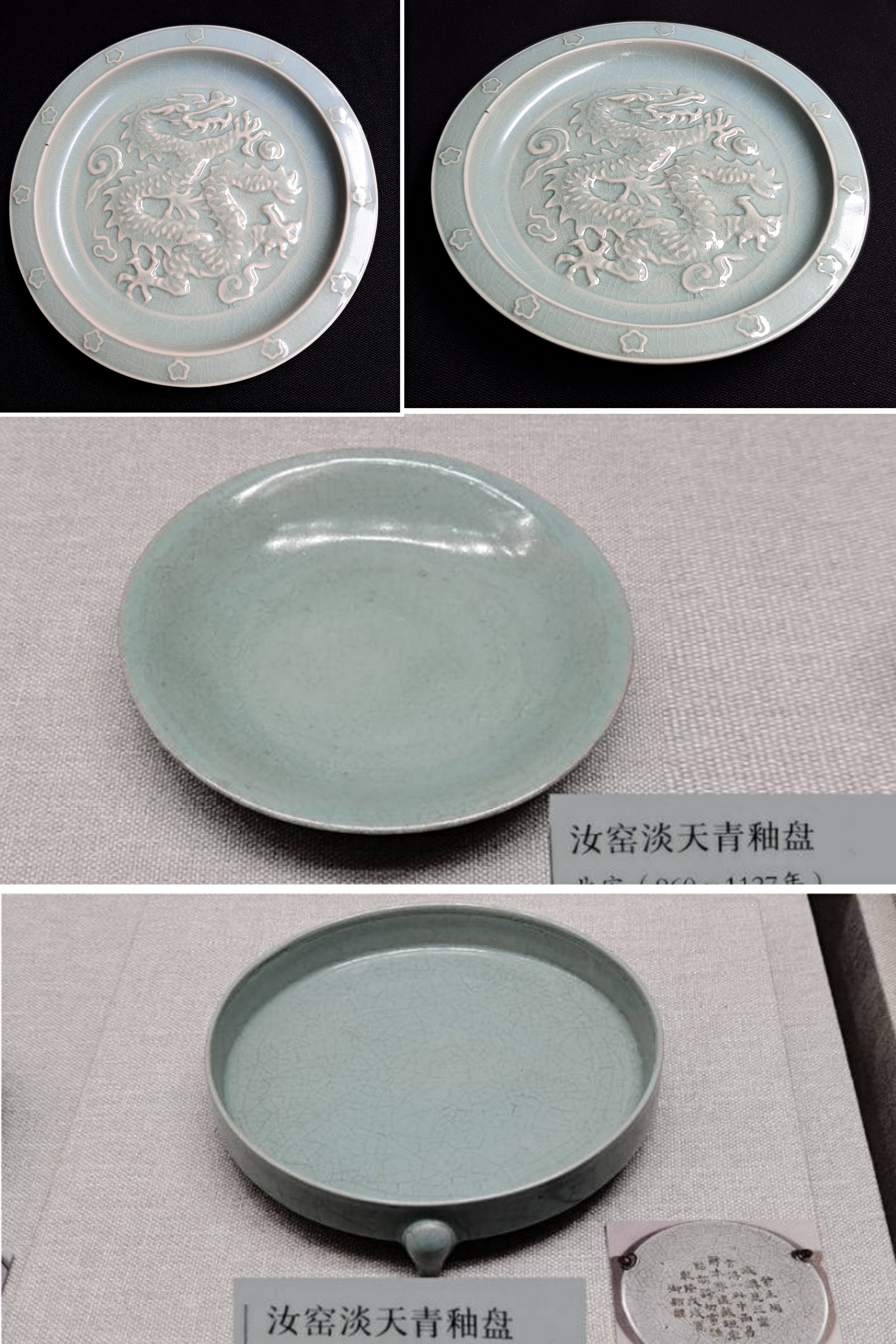
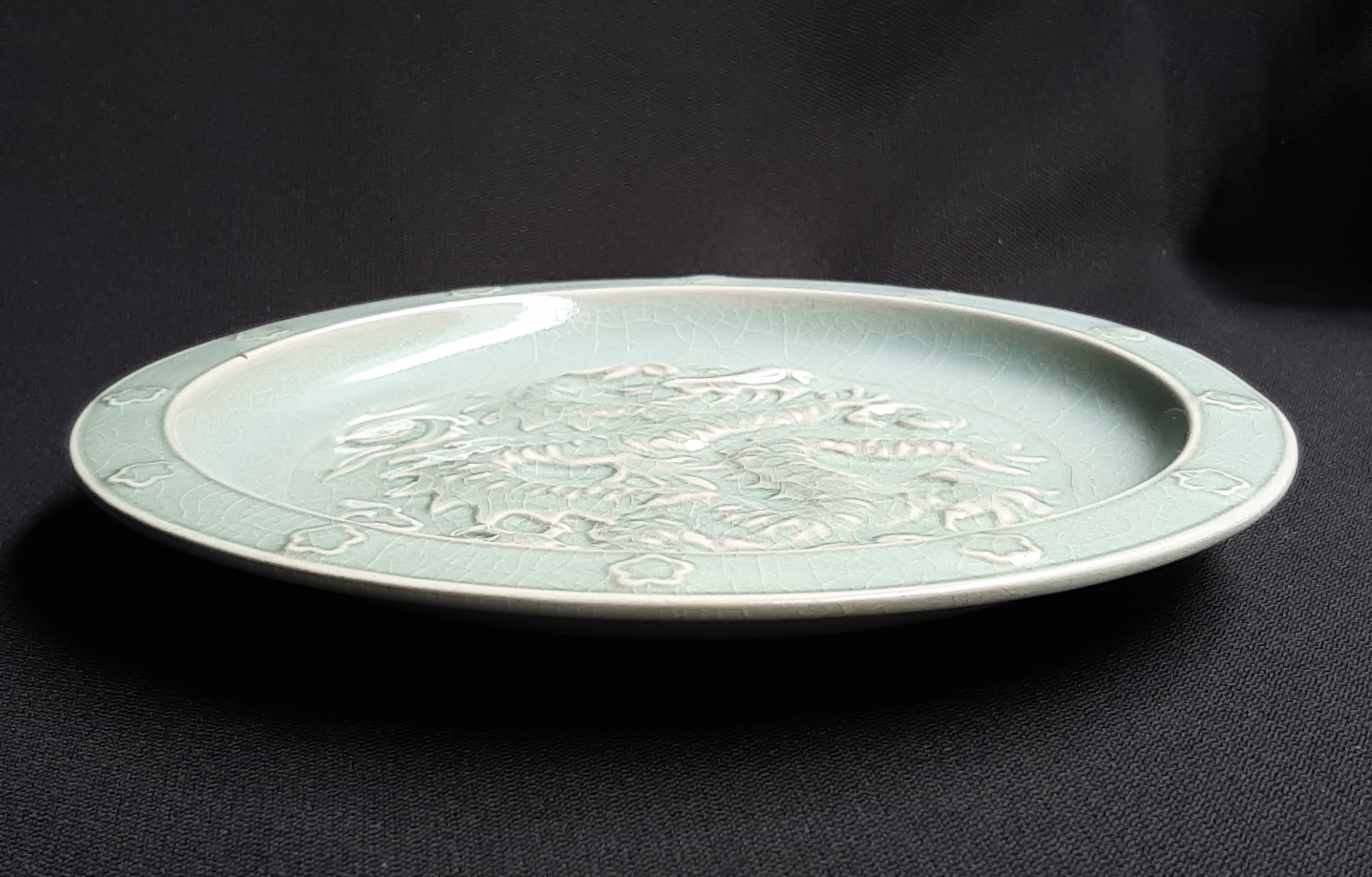
北宋汝窯天青釉刻劃印花五爪龍吐珠十二梅花紋折沿盤
Northern Song Dynasty Ru Kiln Sky-green glazed inscribed and printed Five-clawed Dragon Spit Bead and Twelve Plum Patterns Folding Edge Plate
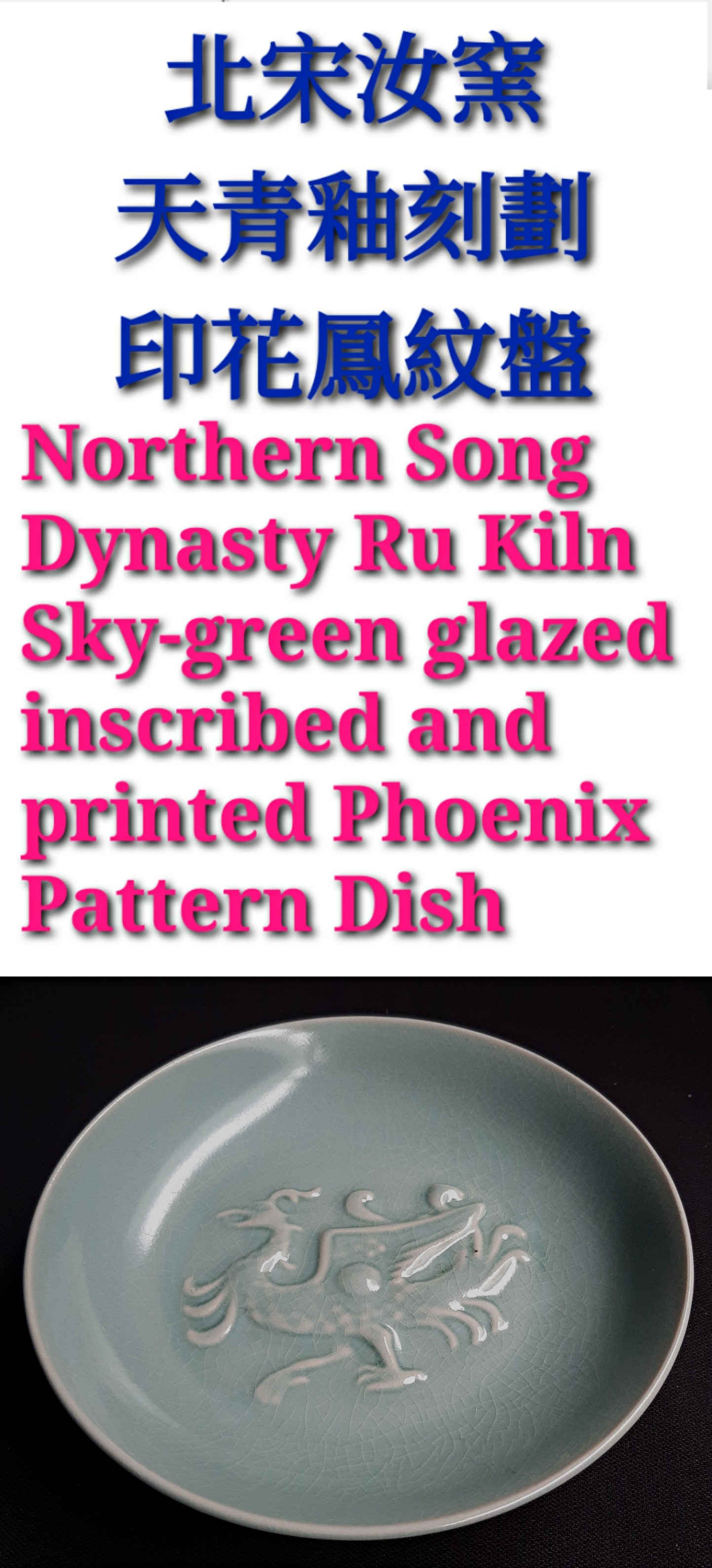
北宋汝窯天青釉刻劃印花鳳紋盤
Northern Song Dynasty Ru Kiln Sky-green glazed inscribed and printed Phoenix Pattern Dish
北宋汝窯天青釉刻劃印花虎紋盤
Northern Song Dynasty Ru Kiln Sky-green glazed inscribed and printed Tiger Pattern Dish
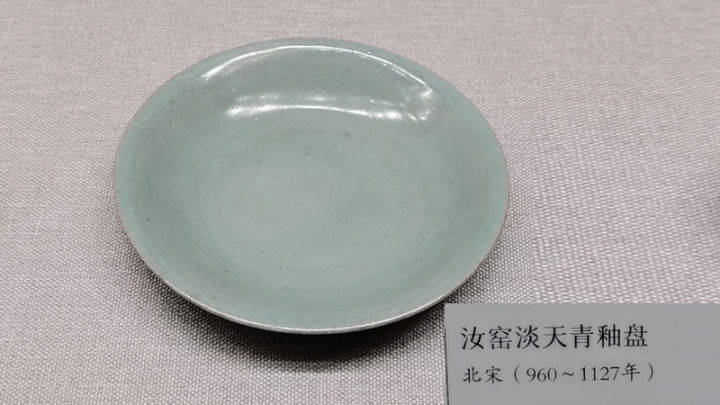
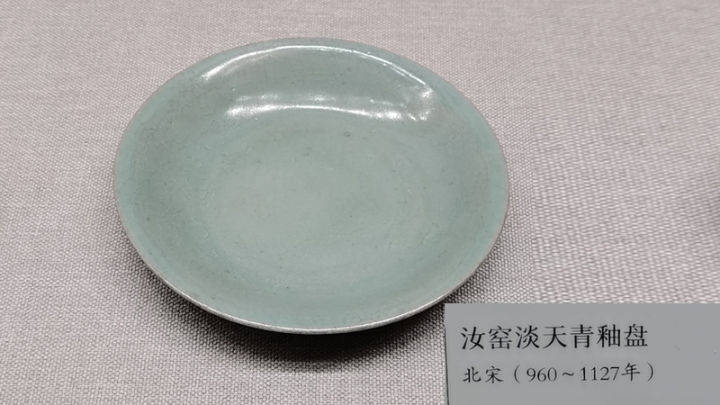
北京故宮博物院藏北宋汝窯淡天青釉盤
Northern Song Dynasty Ru Kiln light Sky-green glazed plate in the Beijing Palace Museum
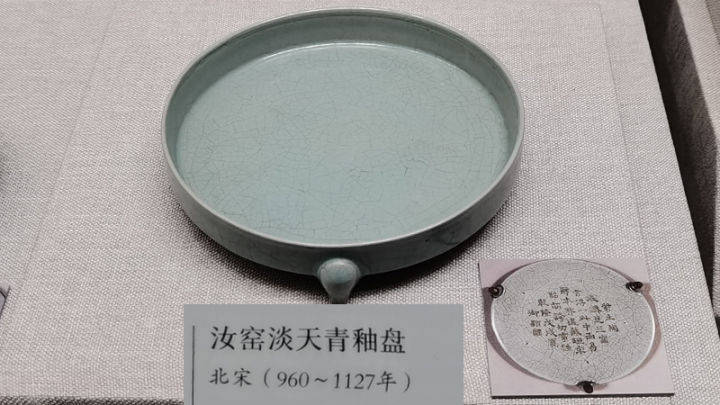
大英博物館藏北宋汝窯瓷器
Northern Song Dynasty Ru Kiln wares in the British Museum
The Royal Craftsmanship Dragon Patterns on the Northern Song Dynasty Jade Carved "Dragon Pattern Plate" and "Jade Plaque composing a jade case with Dragon Pattern Inlays", in the National Palace Museum, Taipei, Taiwan, Republic of China.
As far as the dragon pattern on each porcelain plate is concerned, they are similar to the following " (1) the dragon pattern on the Jade plate with dragon pattern Song to Liao dynasty (907 - 1279 C.E.)", and " (2) the dragon pattern on the Jade plaque composing a jade case, made in the first year (1008 C.E.) of Xiangfu of Emperor Zhenzong reign, Northern Song dynasty", both above are in the collection of the National Palace Museum, Taipei, Taiwan, Republic of China. In comparison, both of each pair are similar, so it is inferred that these dragon-patterned porcelain plates should be the works of Ru Imperial kiln in the Northern Song Dynasty.
Jade plate with dragon pattern, Song to Liao dynasty (907 - 1279 C.E.), in the collection of the National Palace Museum, Taipei, Taiwan, Republic of China.
Unified number of cultural relics: NPM Jade 002251N000000000
As far as the pattern is concerned, such a strong and vigorous dragon pattern is similar to the dragon pattern on the inlay on the jade chamber attached to the "Emperor Zhenzong Jade Plaque composing a jade case of the Northern Song Dynasty", so it is inferred that this plate should belong to the first half of the 11th century, the work of the Liao or Northern Song Dynasties.
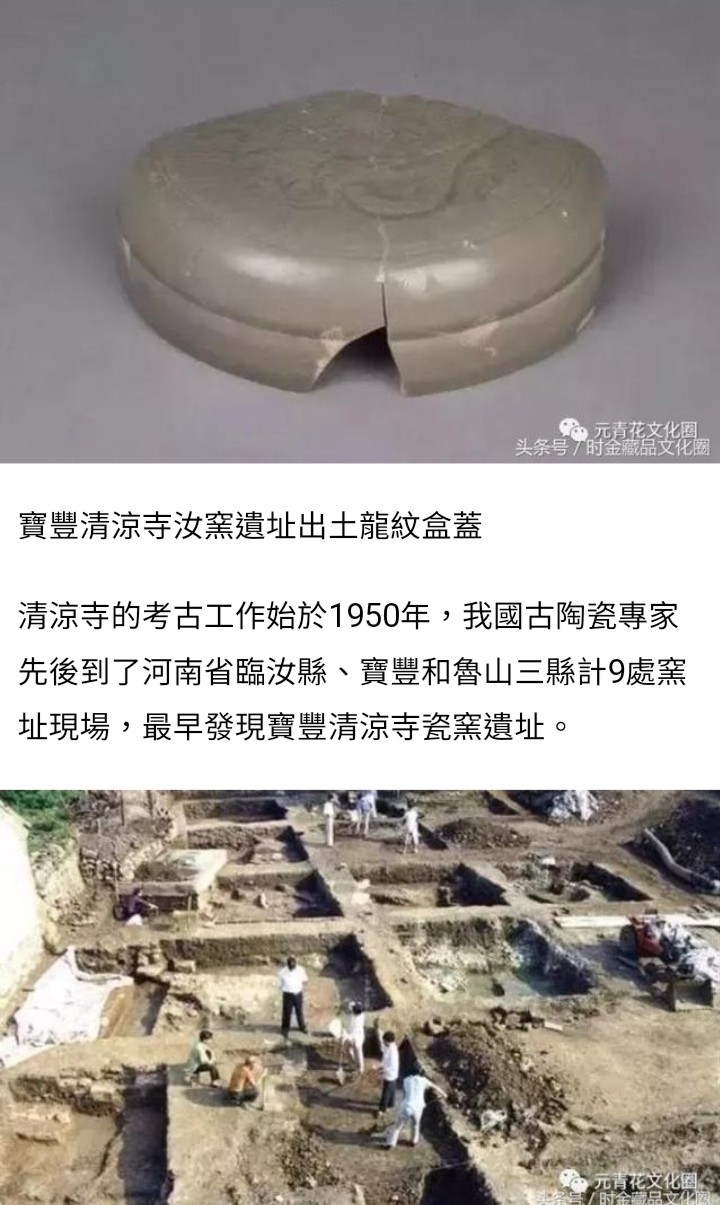
A celadon-glazed printed porcelain box with dragon pattern, late Northern Song Dynasty, unearthed in Area I of Ru Imperial Kiln Site of Qingliang Temple in 1989
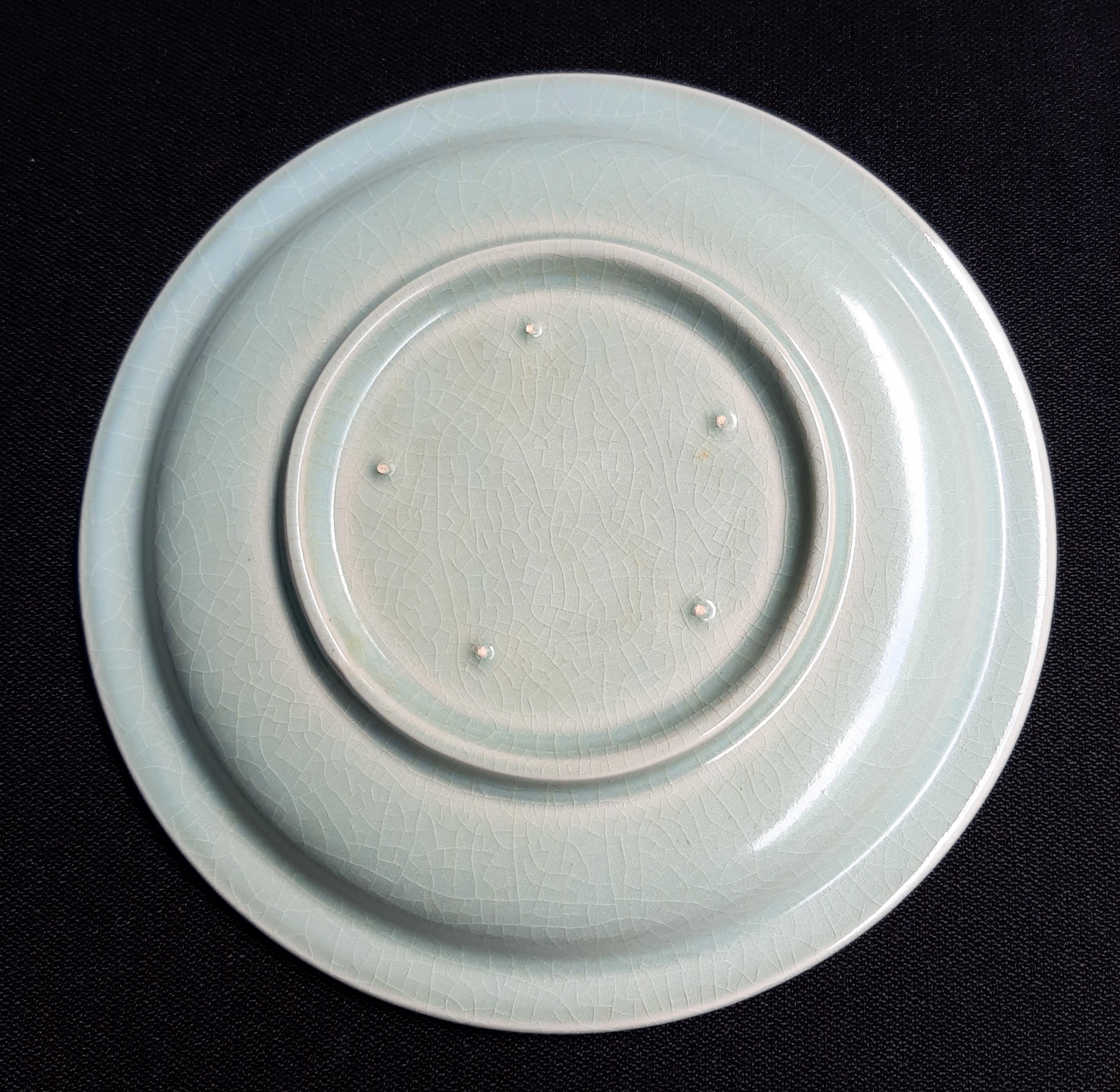
This porcelain plate was full-glazed and burned with supporting-nails, five supporting-nail marks, incense-ash-like-earth-yellow-greyish porcelain body, sky-green glaze, broken-ice-cracking-like cracking-patterns, jade-like smoothness, and five sesame-like supporting-nail marks can be seen on the bottom of the utensil, the marks are very shallow, their sizes are such as sesames.
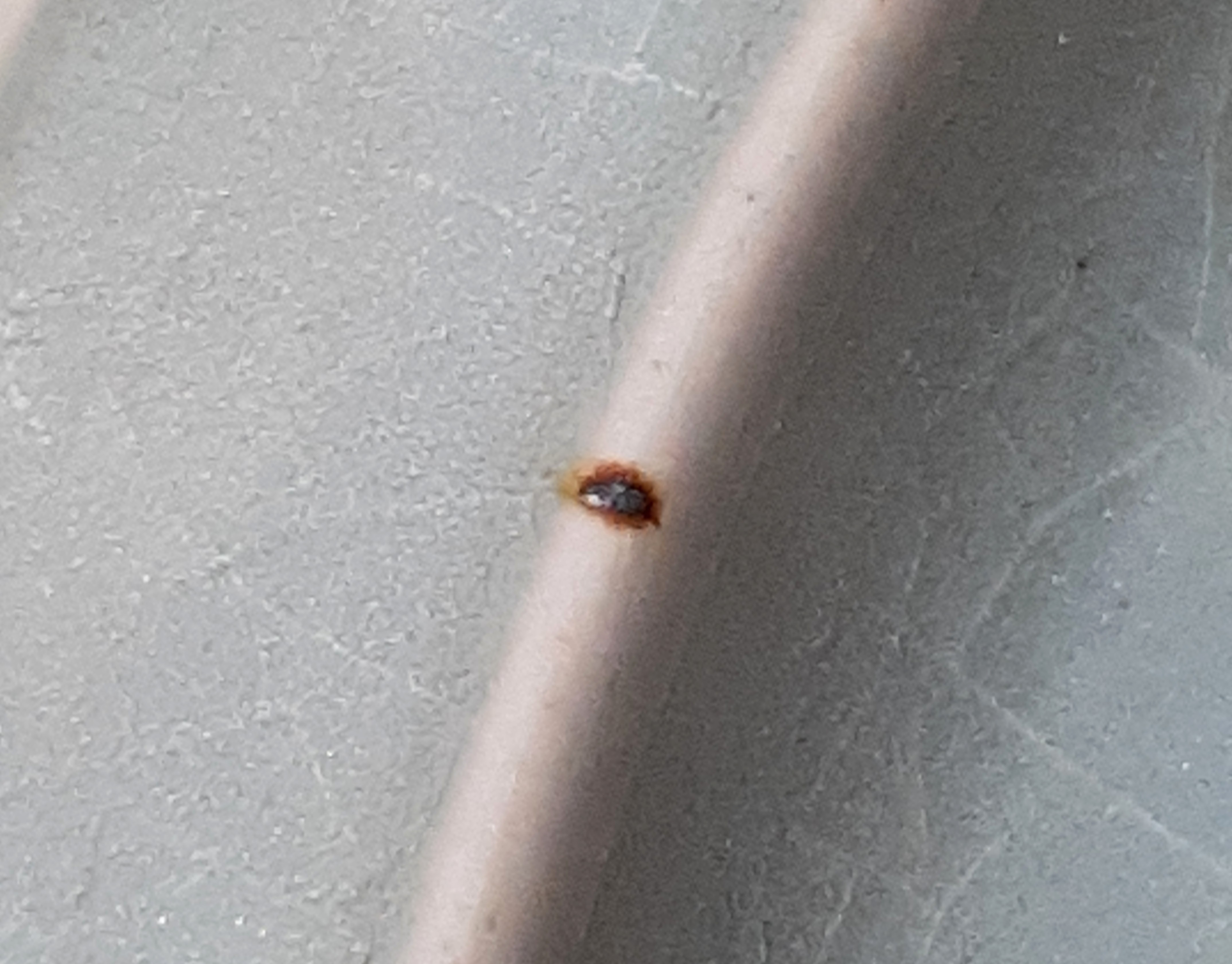
The dragon pattern on the porcelain plate has several "black spots of ancient porcelain flaws", the dragon pattern lines "are all handmade and also show asymmetry between the left and right", and the twelve plum patterns "are different in size, gap, width, and depth, which were obviously formed by hand-carving", there are "marks of agate mixed in the glaze and polyglaze" on both side walls of the bottom ring foot, and an obvious "brown-eye-small-hole" which is an ancient porcelain flaw, on the inner edge line of the folding mouth edge. It was fully glazed with ancient wood-fired air bubbles and broken-ice-cracking-like cracking-patterns. The bottom ring foot is slightly slanted outward.
The porcelain body of this handed down Ru kiln porcelain in the Northern Song Dynasty has three characteristics:
The first is “light and thinness”.
The second is that the porcelain fetal color is incense-ash-like-earth-yellow-greyish, the porcelain fetal bone is light and thin, and the fetal quality seems to be rough but fine. The color of Ru porcelain body is light-gray and gray-white, because its color is similar to the incense ash formed after burning incense, so it is commonly known as "incense gray porcelain body".
The third is that the texture of Ru porcelain is delicate and smooth, firm and compact, and is known as "bronze bone". In addition, people who have come into contact with the handed down Ru porcelain often describe it as "sound like a chime (a musical stone)", which to a certain extent also shows the lightness and compactness of the Ru porcelain body.
In addition, the bottom of the utensil is slightly uneven under the light. Because when the water in the middle of the porcelain mud body was not dry yet and meanwhile the molded mud body was slightly turned left and right to be broken away from the sticking mud mold. So long as the porcelain kiln workers in the Northern Song Dynasty took the above procedure, then the uneven bottom would have been formed. Modern imitations are completely unable to produce slightly uneven bottoms.
Professionals in the modern museums, collectors, connoisseurs, scholars, experts, and so on, because they are all not the Emperor Song Huizong of the Northern Song Dynasty himself, so obviously they have regarded their own taste of being the common people, as the same favorite that should belonged to the Emperor Song Huizong in the Northern Song Dynasty. They generally believed that more than 80 pieces of Ru kiln porcelain handed down on the market should be the personal royal Ru Imperial kiln porcelain wares of the Northern Song Emperor Song Huizong. Do you think it is possible?
The handed down collection from the family ancestor of Chen Xiufu, a military marshal who was assigned by the Ming Emperor Zhu Yuanzhang (Zhu Yuanzhang defeated the Eurasian Empire of the Mongolian Yuan Dynasty), (Chen Xiufu was also the founding hero of the Ming Dynasty, whose official name was Guangludafu, "Guangludafu was the rich and wealthy capitalist of food and money supplied for the emperor's nation-founding and military operations.").
Natural Charming and Amazing Work of Art by the Universe
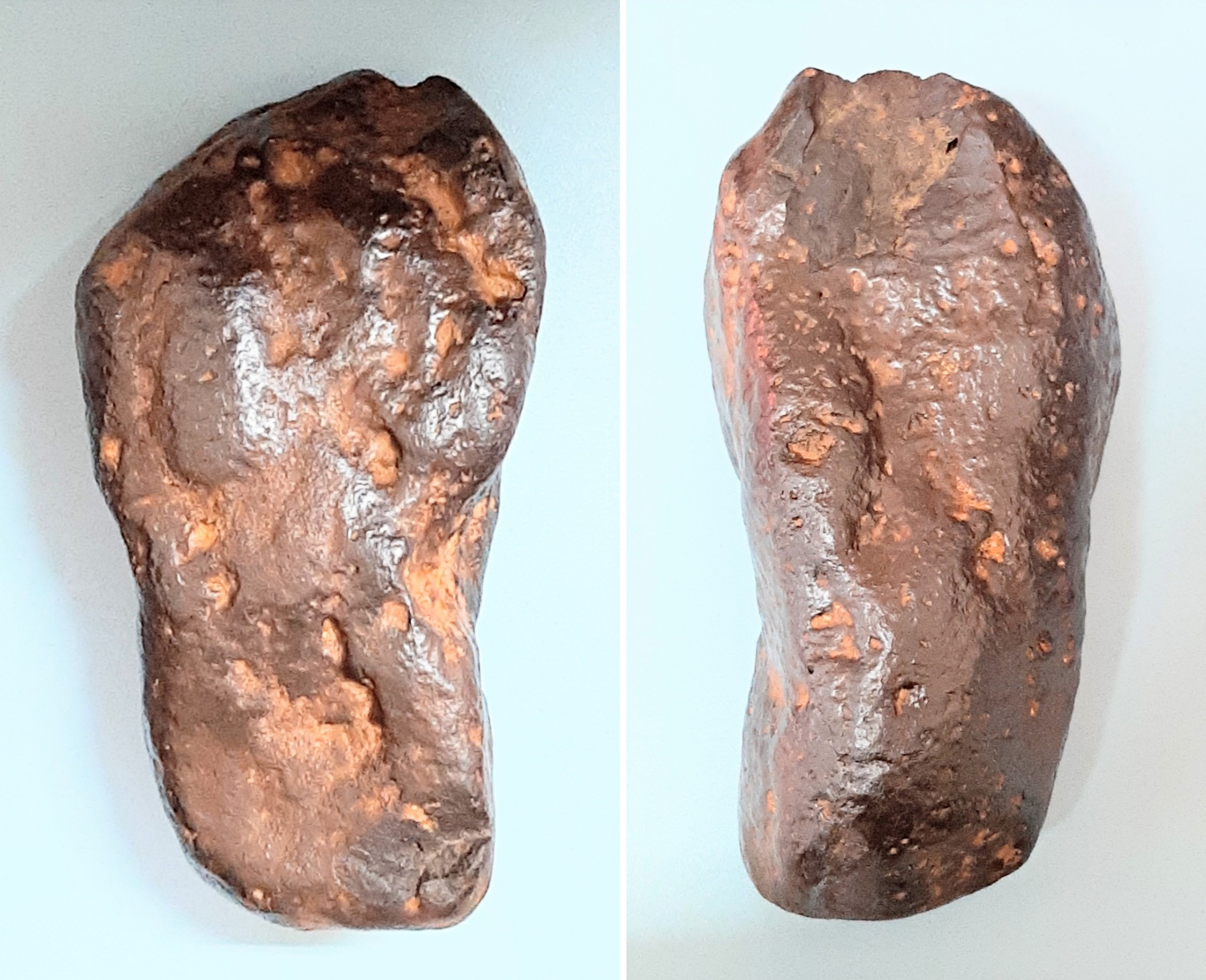
An extremely rare extraterrestrial Alien stone meteorite diamond of the outer space (one side resembles the sole of a human foot, the other resembles the instep of a human foot, and it resembles the footpalm shape of a human foot).
Youtube:
Global audience in March 2022: 1,373 total views and 1,588 total watch time (minutes)
On Earth never has it been found in the past and will not be found in the future.
This meteorite diamond has the features of meteorite regmaglypts (thumbprints), dark black meteorite fusion crust, tiny meteorite fusion flow lines, high specific gravity density of meteorite 3.5, and the magnetic characteristic to attract magnet slightly by a chondrite meteorite. There are some nickel-iron chondrules (silver-white particles) on the surface, chondrules of chondrite stony meteorite, and metallic silver-white particle spots of chondrite stony meteorite being seen on the section or the surface, even on the surface of this meteorite, very tiny diamond crystal grains of a meteorite diamond being seen as well.
Weight: 2,091 grams
Dimensions: Length 16.3 x Width 8.9 x Depth 6.4 cm
Specific Gravity Density: 3.5
The average Specific Gravity Density of Earth's rock: 2.5 - 3.0
The Specific Gravity Density of iron ore: 4.0 - 6.0
The Specific Gravity Density of iron meteorite: 7.0 - 8.0
Most meteorites are composed of heavy minerals and have a Specific Gravity Density of 3.0 - 8.0
The Specific Gravity Density of Stone Meteorite: 3 - 3.5
The Specific Gravity Density of normal meteorites: 3.0 - 3.7
The Specific Gravity Density of lunar meteorites: 2.7 - 3.8
The iron-nickel metal content of stony meteorites is less than or equal to 30%;
The iron-nickel metal content of stony-iron meteorites is between 30% and 65%;
The iron-nickel metal content of iron meteorites is greater than or equal to 95%.
Glass meteorites do not contain metallic components.
"Stony meteorite" is divided into "chondrite" (mostly) and "achondrite", two sub-categories.
Stony meteorites are debris from other celestial bodies in the solar system other than Earth, most of which come from asteroids located between Mars and Jupiter.
Chondrites are stony meteorites whose celestial parent bodies have not been melted or differentiated, and without changing.
Chondrites were formed by the accretion of dust and sand particles that existed in the original solar system and produced asteroids more than 4.55 billion years ago. The asteroid parent bodies of these chondrites are (or were) small to medium-sized asteroids, that were part of small solar system bodies, that were never large enough to undergo melting and planetary differentiation.
One of their characteristics is the presence of chondrules, which are circular grains of different minerals, and typically make up 20 to 80 percent of the volume of the chondrite. Their spherulites are generally between 0.5 and 1 mm in diameter.
The metal particles in chondrites are mainly iron and nickel, and the presence of nickel is also a common indicator for determining whether a stone is a meteorite.
Weight: 2,091 grams
The international price of "meteorite diamonds" is at least NT$750 million per piece (more than US$ 25 million, please refer to "Meteorite Diamonds - Baidu Encyclopedia"
At present, only three "meteorite diamonds" have been found in the world, one in the People's Republic of China, two in the United States, and three "seems to be the largest" in Taiwan, the Republic of China.
Youtube:
Global audience in March 2022: 1,373 total views and 1,588 total watch time (minutes)
This porcelain plate was full-glazed and burned with supporting-nails, five supporting-nail marks, incense-ash-like-earth-yellow-greyish porcelain body, sky-green glaze, broken-ice-cracking-like cracking-patterns, jade-like smoothness, and five sesame-like supporting-nail marks can be seen on the bottom of the utensil, the marks are very shallow, their sizes are such as sesames.
The dragon pattern on the porcelain plate has several "black spots of ancient porcelain flaws", the dragon pattern lines "are all handmade and also show asymmetry between the left and right", and the twelve plum patterns "are different in size, gap, width, and depth, which were obviously formed by hand-carving", there are "marks of agate mixed in the glaze and polyglaze" on both side walls of the bottom ring foot, and an obvious "brown-eye-small-hole" which is an ancient porcelain flaw, on the inner edge line of the folding mouth edge. It was fully glazed with ancient wood-fired air bubbles and broken-ice-cracking-like cracking-patterns. The bottom ring foot is slightly slanted outward.
The porcelain body of this handed down Ru kiln porcelain in the Northern Song Dynasty has three characteristics:
The first is “light and thinness”.
The second is that the porcelain fetal color is incense-ash-like-earth-yellow-greyish, the porcelain fetal bone is light and thin, and the fetal quality seems to be rough but fine. The color of Ru porcelain body is light-gray and gray-white, because its color is similar to the incense ash formed after burning incense, so it is commonly known as "incense gray porcelain body".
The third is that the texture of Ru porcelain is delicate and smooth, firm and compact, and is known as "bronze bone". In addition, people who have come into contact with the handed down Ru porcelain often describe it as "sound like a chime (a musical stone)", which to a certain extent also shows the lightness and compactness of the Ru porcelain body.
In addition, the bottom of the utensil is slightly uneven under the light. Because when the water in the middle of the porcelain mud body was not dry yet and meanwhile the molded mud body was slightly turned left and right to be broken away from the sticking mud mold. So long as the porcelain kiln workers in the Northern Song Dynasty took the above procedure, then the uneven bottom would have been formed. Modern imitations are completely unable to produce slightly uneven bottoms.
Professionals in the modern museums, collectors, connoisseurs, scholars, experts, and so on, because they are all not the Emperor Song Huizong of the Northern Song Dynasty himself, so obviously they have regarded their own taste of being the common people, as the same favorite that should belonged to the Emperor Song Huizong in the Northern Song Dynasty. They generally believed that more than 80 pieces of Ru kiln porcelain handed down on the market should be the personal royal Ru Imperial kiln porcelain wares of the Northern Song Emperor Song Huizong. Do you think it is possible?
The handed down collection from the family ancestor of Chen Xiufu, a military marshal who was assigned by the Ming Emperor Zhu Yuanzhang (Zhu Yuanzhang defeated the Eurasian Empire of the Mongolian Yuan Dynasty), (Chen Xiufu was also the founding hero of the Ming Dynasty, whose official name was Guangludafu, "Guangludafu was the rich and wealthy capitalist of food and money supplied for the emperor's nation-founding and military operations.").
Dimensions: Length 22.8 x Width 4.4 x Height 3.3 cm
The "Shan Hai Jing" records that there was nine-tailed fox on the mountain of Qingqiu. This nine-tailed fox, studied by scholars, was likely to be the nine clans, or a totem worshipped by the local clan. Even King Zhou Wenwang (周文王) presented a nine-tailed fox to King Shang Zhou (商紂王). King Zhou Wenwang (周文王) was imprisoned in Yuli by King Shang Zhou (商紂王), and in order to rescue him, the subjects in Kingdom Xiqi searched everywhere for rare birds and animals. San Yisheng obtained a nine-tailed fox and presented it to King Shang Zhou (商紂王) along with other treasures. When King Shang Zhou (商紂王) was pleased, he released Ji Chang [King Zhou Wenwang (周文王)]. The original text is:
King Zhou Wenwang (周文王) was detained in Yuli, San Yisheng went to the coast of the West Sea, and took the white fox and qinghan (green pheasant) to present to King Shang Zhou (商紂王), and King Shang Zhou (商紂王) was very pleased. ("The Great Biography of Shangshu", Qinghan, the green pheasant)
San Yisheng went to Wu and got a nine-tailed fox to offer King Shang Zhou (商紂王). (The Note of "You Tong Fu")
Therefore, King Zhou Wenwang (周文王) was saved because of the "nine-tailed fox", so he used a gilt bronze war robe hook, with dragon head, fox pattern hook body and hook tail.
The handed down collection from the family ancestor of Chen Xiufu, a military marshal who was assigned by the Ming Emperor Zhu Yuanzhang (Zhu Yuanzhang defeated the Eurasian Empire of the Mongolian Yuan Dynasty), (Chen Xiufu was also the founding hero of the Ming Dynasty, whose official name was Guangludafu, "Guangludafu was the rich and wealthy capitalist of food and money supplied for the emperor's nation-founding and military operations.").
Fossil stone plate size: length 18.0 x width 14.2 x thickness 0.9 cm
Sauroposeidon (meaning "lizard earthquake god" after the Greek god Poseidon) is a genus of sauropod dinosaur known from several incomplete specimens including a bone bed fossil and fossilized trackways that have been found in the U.S. states of Oklahoma, Wyoming, and Texas.
Sauroposeidon was living in the early Cretaceous. Sauroposeidon was the tallest known dinosaur, at an estimated height of 17 meters; its body length was nearly 30 to 34 meters, and its weight was estimated to be between 50 and 60 metric tons.
Several specimens have been found so far. The holotype is composed of 4 cervical vertebrae. It was discovered in Oklahoma, USA in 1994. Fossils and footprint fossils were also found in Wyoming and Texas. The geological age belongs to the early Cretaceous period. It used to be the delta of the prehistoric Gulf of Mexico. The fossils were once thought to be petrified wood because few giant sauropod fossils from this era have been found before.
Published bibliography:
《Dinosaurs and Meteorites 恐龍與隕石 恐龙与陨石 恐竜と隕石》Published by Google Books USA and distributed in 79 countries around the world:
Dimensions: total length 16.7 cm x height 5.6 cm x depth 5.1 cm
The distinctive color and brilliance of jade make people love it at all costs. In ancient times, due to the small quantity and difficulty in processing, it became a rare luxury. It must be owned by a person of extremely high social status, and the jade carved artifact had become a symbol of power, which has gradually evolved it into a ritual tool and a sacrificial tool. The jade carved artifact was transformed from a special kind of stone into a symbol of power, status, wealth, and theocracy.
In ancient times, the pig was a symbol of wealth. In the Han Dynasty and Tang Dynasty, if the sheep represented auspiciousness, then the pig was a symbol of wealth. In these Dynasties, the pig was an important symbol of wealth, and the pig was also a must-have domestic animal in a wealthy family. Therefore within the Chinese character of "home", "hog" is the hieroglyph of the pig. It can be seen that in the ancient Han Dynasty and Tang Dynasty, the pig was indeed an important property of the imperial family and the people of these Dynasties, and it was one of the symbols of wealth.
The material of the jade Seven Pigs (representing infinite wealth) paperweight and the cortical surface of the white jade have been slurried and oxidized into a jade shell, and the iron element on the surface of the jade stone skin has also been oxidized to red. However, no patterns’ decoration of the imperial jade carvings of the Han Dynasty was carved on it. It can be confirmed that this jade Seven Pigs (representing infinite wealth) paperweight is a royal craftsmanship of the Tang Dynasty (618 - 907) and a skillful circular carving of white jade.
The handed down collection from the family ancestor of Chen Xiufu, a military marshal who was assigned by the Ming Emperor Zhu Yuanzhang (Zhu Yuanzhang defeated the Eurasian Empire of the Mongolian Yuan Dynasty), (Chen Xiufu was also the founding hero of the Ming Dynasty, whose official name was Guangludafu, "Guangludafu was the rich and wealthy capitalist of food and money supplied for the emperor's nation-founding and military operations.").
Dimensions: total height 19.6 cm x width 6.5 cm x depth 5.8 cm
The prosperous Tang Dynasty can be said to be the golden age of Buddha statues. The statues in this period are well-proportioned in proportion and reasonable in structure. They have completely gotten rid of the large head and slightly rigid body of the Buddha in the Sui and early Tang Dynasties, and the dynamics are extremely free and lively. He has a spiral hair on his head, large drooping ears, and a dignified yet kind expression. The body is well-proportioned, the structure is reasonable, the body is naturally stretched, the face is round, the eyebrows are plumply curved and the neck is full, and the facial features are beautiful. The apparels are gorgeous, shawl (shawl is the embellishment of beautiful women's Tang suits, that is, we see a long strip on the shoulders or arms of the women in the Tang Dynasty in the painting, walking with the wind swinging, looking elegant and natural, this is the shawl) is around the body. Wreath (wreath is a kind of decorations hanging on the neck and the chest, made of a variety of small flowers.) is small and delicate, the clothes' lines are smooth and natural. The right hand holds a treasure orb.
The material of the jade Buddha statue and the cortical surface of the white jade have been slurried and oxidized into a jade shell, and the iron element on the surface of the jade stone skin has also been oxidized to red. The head is spiral hair and the big ears are drooping. The body is well-proportioned, the structure is reasonable, wearing in Tang Dynasty shawl, and holding a treasure orb in the right hand. It can be confirmed that this jade Buddha statue is a royal craftsmanship of the Tang Dynasty (618 - 907) and a skillful circular carving of white jade.
The handed down collection from the family ancestor of Chen Xiufu, a military marshal who was assigned by the Ming Emperor Zhu Yuanzhang (Zhu Yuanzhang defeated the Eurasian Empire of the Mongolian Yuan Dynasty), (Chen Xiufu was also the founding hero of the Ming Dynasty, whose official name was Guangludafu, "Guangludafu was the rich and wealthy capitalist of food and money supplied for the emperor's nation-founding and military operations.").
Dimensions: total height 19.9 cm x width 9.8 cm x depth 8.8 cm
The distinctive color and brilliance of jade make people love it at all costs. In ancient times, due to the small quantity and difficulty in processing, it became a rare luxury. It must be owned by a person of extremely high social status, and the jade carved artifact had become a symbol of power, which has gradually evolved it into a ritual tool and a sacrificial tool. The jade carved artifact was transformed from a special kind of stone into a symbol of power, status, wealth, and theocracy.
The prosperous Tang Dynasty can be said to be the golden age of Buddha statues. The statues in this period are well-proportioned in proportion and reasonable in structure. They have completely gotten rid of the large head and slightly rigid body of the Buddha in the Sui and early Tang Dynasties, and the dynamics are extremely free and lively. She has large drooping ears, and a dignified yet kind expression. The body is well-proportioned, the structure is reasonable, the body is naturally stretched, the face is round, the eyebrows are plumply curved and the neck is full, and the facial features are beautiful. The apparels are gorgeous, shawl (shawl is the embellishment of beautiful women's Tang suits, that is, we see a long strip on the shoulders or arms of the women in the Tang Dynasty in the painting, walking with the wind swinging, looking elegant and natural, this is the shawl) is around the body. Wreath (wreath is a kind of decorations hanging on the neck and the chest, made of a variety of small flowers.) is small and delicate, the clothes' lines are smooth and natural. The two hands of Avalokitesvara Bodhisattva hold a clean water bottle.
The material of the jade Avalokitesvara Bodhisattva lotus pedestal statue and the cortical surface of the white jade have been slurried and oxidized into a jade shell, and the iron element on the surface of the jade stone skin has also been oxidized to red. The head's big ears are drooping. The body is well-proportioned, the structure is reasonable, wearing in Tang Dynasty shawl, and the two hands of Avalokitesvara Bodhisattva hold a clean water bottle. It can be confirmed that this jade Avalokitesvara Bodhisattva lotus pedestal statue is a royal craftsmanship of the Tang Dynasty (618 - 907) and a skillful circular carving of white jade.
The handed down collection from the family ancestor of Chen Xiufu, a military marshal who was assigned by the Ming Emperor Zhu Yuanzhang (Zhu Yuanzhang defeated the Eurasian Empire of the Mongolian Yuan Dynasty), (Chen Xiufu was also the founding hero of the Ming Dynasty, whose official name was Guangludafu, "Guangludafu was the rich and wealthy capitalist of food and money supplied for the emperor's nation-founding and military operations.").


%206000%20(2)%20(2).png)
%206000%20(3)%20(1).png)
%206000%20(3).png)


%206000%20(2)%20(2)%20(1).png)
%206000%20(2).png)


%20(3).png)

.png)

%206000%20(2)%20(1).png)


%20(2).png)

.png)


%206000%20(2)%20(1).png)
%206000%20(2).png)




%206000%20(2).png)
.png)

.png)

.png)

.png)


%206000%20(2).png)
.png)


.png)

.png)


.png)


%206000%20(2)%20(2).png)
%206000%20(2).png)
%206000%20(3).png)
%206000%20(4)%20(2).png)
%206000%20(5)%20(2).png)
%206000.png)


.jpg)
.png)


%206000%20(2)%20(2)~2.png)
%206000%20(2)~2.png)
%206000%20(3)~2.png)










.jpg)